Queries 10.05: Harvest news, a mouthfeel wheel, and Hop Calculus

* US production steady
* Bad news out of Europe
* Hop quiz
* Mouthfeel wheel
* Hop Calculus
* Additional reading

Welcome to Volume 10, No. 5. Whoosh! That was the sound of the last month flying by. Hanging out for the first round of the Fresh Hop Rodeo was a blast. Here are a few photos. Then I was back in Yakima last week, sitting in during hop selection here and there while collecting information that will end up in stories at Brewing Industry Guide and here. I’ll be back again in less than two works for The Original Fresh Hop Festival.

A FEW POUNDS MORE, A FEW POUNDS LESS

Here is a snapshot from the Hopsteiner global crop estimate for 2026. Hopsteiner’s estimates in recent years for overall crop totals have been mostly spot on, but we will have to wait for the USDA report in December to certain about how many pounds of Citra, Krush or Sterling farmers harvested. Yes, the last two are among those won’t see below, emphasizing that “other varieties” constitute about one third of production and include many that brewers are particularly interested in.

Also, remember that a metric ton is equal to 2,204.6 pounds and a hectare to 2.47 acres. For sake of comparison, a yield of 2,000 pounds per acre is comparable to 2.24 metric tons per hectare.

2026 US estimated hop crop from Hopsteiner

The Hopsteiner estimate for the global hop crop is 95,152 metric tons, 12% less than 2025 and only 73% of 2021 production.

CLIMATE CHANGE HAMMERS EUROPEAN HOPS

First, a quick summary from a post at the beginning of the month about the hop havoc that resulted because of an intense heat wave and below average rainfall across Europe.

– The Association of German Hop Growers estimates they will harvest 33,779 metric tons (about 75 million pounds), compared to 43,141 in 2025.

– The Czech Hop Growers Union estimates production will be down about 25% from 5,207 metric tons in 2025. The official results from alpha screening by the Czech Chmelarsky Institut show historically low alpha values of 1.8% for Saaz.
Read more

Very bad news from European hop fields

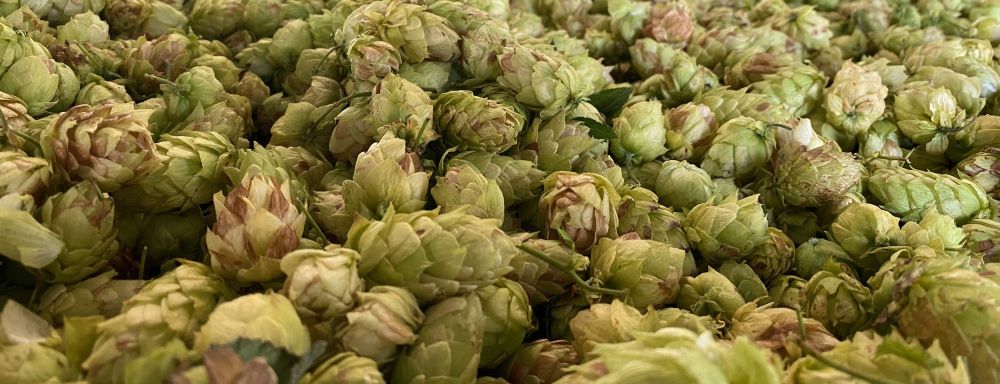
Freshly picked hops in the process of being dried

For the second time in five years, hop production across Europe has tumbled as a result of an intense heat wave and below average rainfall.

– The Association of German Hop Growers estimates they will harvest 33,779 metric tons (about 75 million pounds), compared to 43,141 in 2025. As a result, the industry expects the value of the 2026 crop will fall €80 to €100 million short of expected revenue of about €300 million.

Reacting to shrinking demand for hops worldwide, German farmers strung 5.8% fewer acres in 2026. Lower yields are to blame for most of the 22% drop in production. That mirrors 2022, when farmers harvested 34,406 metric tons.

– The Czech Hop Growers Union estimates production will be down about 25% from 5,207 metric tons in 2025. That works out to about a bit less than 4,000 metric tons and is not as disastrous as the drop from 6,662 MT in 2021 to 3,127 in 2022. The official results of alpha screening by the Czech Chmelarsky Institut show historically low alpha values of 1.8% for Saaz.

– In Slovenia, in addition to the heat repeated hailstorms damaged about half 4,000 acres strung for harvest, with losses in yield between 10% and 100%.

– In Poland, frost damaged hops in some fields at the beginning of the season and the area suffered through the same high heat and low moisture conditions as the rest of Europe.

In Germany the temperature topped 30℃ (86℉) during 45 days. There has not been a heatwave of such duration and intensity in at least 25 years. During the crucial growth period between mid-June until mid-August precipitation at Hüll (in the Hallertau region) amounted to only 105 mm (4 inches), about half the long-term average.

HVG, the German hop cooperative, reported the persistent heat impaired flowering and cone development of the early varieties. For the first time, individual shoots in the upper section of Herkules, which accounts for about half of German production, died back due to the heat, and bines struggled to reach the top of the trellis.

The conditions made the differences between irrigated and non-irragated fields (the latter are more common in Germany) apparent. Heat-resistant varieties such as Polaris and Mandarina Bavaria appeared much healthier and more productive in many locations than numerous classic varieties.

Queries 10.4: More reasons not to fear ‘old’ hops

* What Strata tells us
* Hop quiz
* The Terra family
* Random observation
* Mac Hops turns to brewing

Welcome to Volume 10, No. 4. Hop harvest has begun in the Northwest. Fresh hop ales are already being poured. How could that be? I wrote about why there are questions about when “wet hop” season should begin and why those beers can still taste really good in October for Brewing Industry Guide.

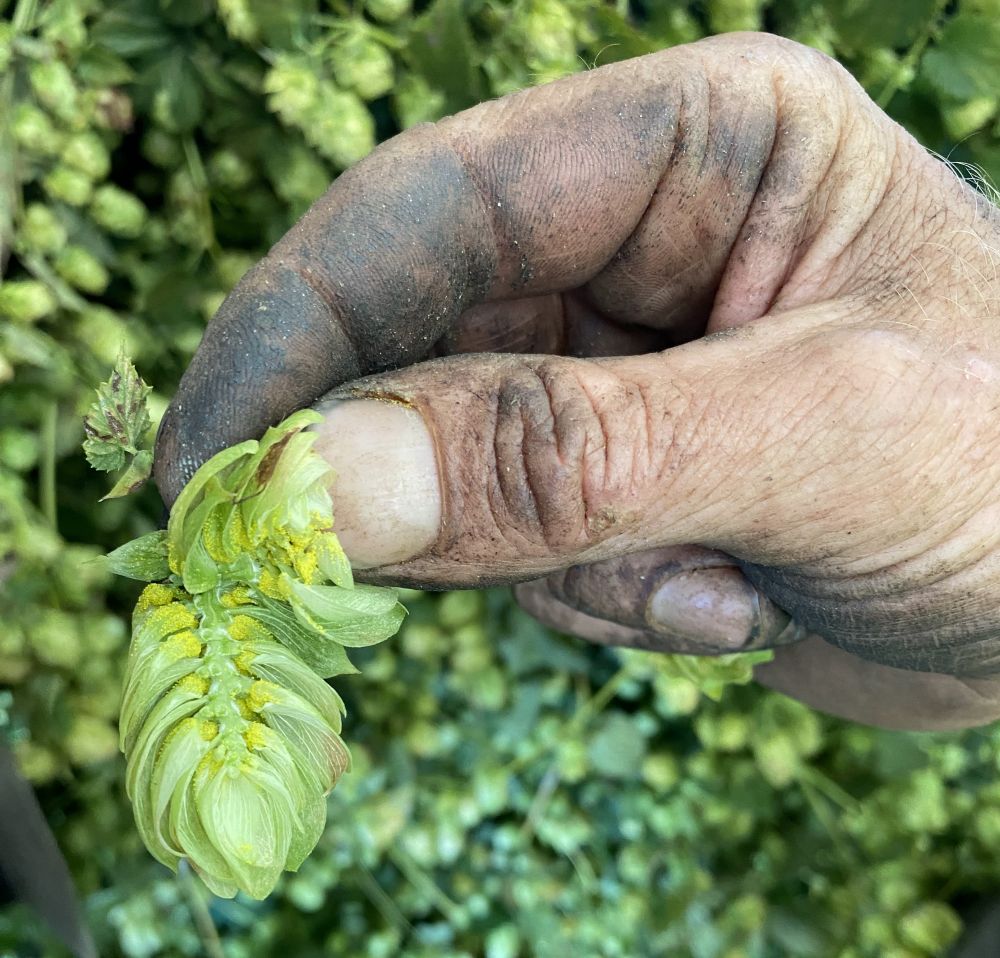
The hands of a hop farmer

STORAGE STABILITY AND VINTAGE DEPENDENCE

Last month I recommended listening to one of two podcasts with Tom Shellhamm and Cecile Chenot at Oregon State University. They featured information from two studies. One examined the aging of Citra, Cascade, and Centennial under commercial storage and the discrepancies between sensory quality and HSI classification. The other evaluated Strata across multiple harvest years, farms, and fields, focusing on terpene and polyfunctional thiol profiles. I already summarized the key takeaways from the first for Brewing Industry Guide in March. Here are the highlights from the Strata study:

– Strata is particularly rich in 3S4MP, with levels up there with Mosaic, Nelson Sauvin, Thora and Hallertau Blanc.

– However, concentrations varied by about five-to-seven-fold between certain harvest years and field combinations. It does not work to simply plug 150 parts per trillion into a formula to calculate the possible level of 3S4MP your Strata addition is contributing to a beer.

– From a chemical standpoint Strata displayed notable stability from year to year when stored properly (cold and in low-oxygen packaging).

– Oxygen is a bitter enemy of hop aroma. As expected, the most pronounced losses were observed in the monoterpene fraction when high-oxygen samples were compared to low-oxygen one, while sesquiterpene hydrocarbons remained comparatively stable. Among free thiols, 4SMP was the most sensitive, with concentrations deceasing by about 50 percent, while 3SH and 3S4MP lost 15 to 20 percent.

HOP QUIZ

What is the year exed out in this statement refer to? Taken from the annual BarthHaas Hop Report.

Starting with the harvest of [xxxx] the shift a buyer’s market could no longer be overlooked. Hop production again exceeded consumption. Further factors contributed to the situation:

Read more

HBC launches Terra Alpha hops

John I. Haas suggests the “future of alpha is Terra.”

I’m focused on the ASBC and CIBC Meeting in Seattle this week to I will let this lightly edited press release do the heavy lifting.

Hop Breeding Company (HBC), together with partners John I. Haas and Yakima Chief Ranches, today announced the launch of Terra Alpha Hops, a new series of high-alpha hop varieties bred for reliable performance in both the field and the brewhouse.

“HBC is well known for our intense flavor-forward hops (Citra, Mosaic, Krush, Dolcita, etc.), but innovation in alpha has also been an important part of our breeding program,” says Jennifer Burns, Executive Director of Hop Breeding Company. “TerraFlux has already proven itself at commercial scale, and TerraSurge represents the next generation of that work. With our Terra Alpha series, we’re giving that part of our portfolio an identity of its own.”

TerraSurge is HBC’s newest high-alpha variety, combining exceptionally high yield with powdery mildew resistance and a late harvest window. Together, these agronomic advantages give growers greater flexibility and offer the potential for more efficient, sustainable hop production.

“TerraSurge encompasses every innovation we’ve developed over the last seven years. It’s a breakthrough,” says Michael Ferguson, Director of Hop Breeding at John I. Haas. “That’s what we want a hop to look like.”

The TerraFlux name brings a new identity to the established variety HBC 682, commercially grown since 2018. With more than 36 million pounds produced to date, its impressive history makes TerraFlux a natural complement to the newly introduced TerraSurge.

Should you be confused, TerraFlux/HBC 682 was given the name Pahto when she was released. However, her named was officially changed back to HBC 682 a few years ago. The name Pahto is the word indigenous people used for Mount Adams, which is prominent in the Yakima Valley.

Hop harvest is coming; wildfires are already here

Monday, the Oregon Hop Growers Association issued a press release that began:

“Next week, many of Oregon’s hop growers will begin the first round of harvest, with fresh hop beer season soon to follow as brewers pick up fresh hops from local farms for a once-a-year beer experience unique to the Pacific Northwest. Growers and brewers say Oregon beer drinkers should be especially excited about this year’s batch, as favorable weather yielded high-quality hops.

“’After a few tough years with hop acreages declining as beer sales dipped, Oregon hop growers are especially excited about this year’s hop harvest. The mild spring resulted in ideal growing conditions for the hops, meaning we’re expecting great flavor and aroma,’ said Michelle Palacios, executive director of the Oregon Hop Growers Association.”

What could go wrong?

Smoke, as growers and brewers learned with the 2020 harvest.

Wildfires in Central and Eastern Washington triggered an air quality alert in the Yakima Valley this week. It is also higher today in Oregon’s Willamette Valley, although forecasts are for more favorable conditions soon.

If you want to worry about this on a daily basis, a few links:

– Washington smoke blog.

– Yakima Valley air quality information. Scroll down for map.

– Willamette Valley air quality information. Scroll down for map.